




loading count
loading pagination
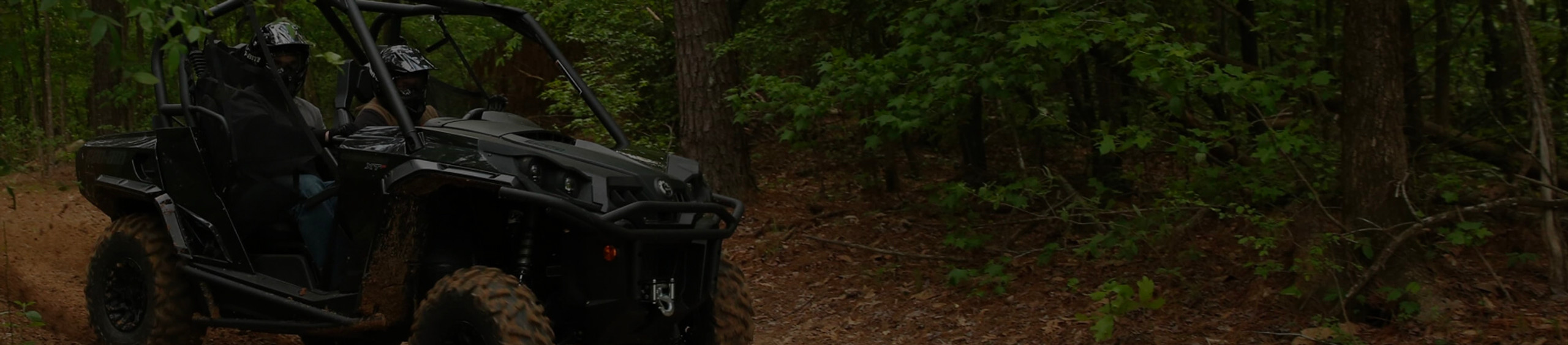
Nobody buys a winch on a good day. You buy one after the afternoon you spent digging a Ranger out of a creek bottom with a shovel and a ratchet strap, or the morning a downed tree turned a 20-minute ride into a two-hour walk. A winch is the accessory that turns a stuck machine into an inconvenience instead of a phone call, and if you plow, it is not optional at all — it is what lifts the blade. We carry 256 winches across every make we cover, Polaris, Can-Am, Honda, Kawasaki, Yamaha, CFMoto, Arctic Cat, John Deere and Kubota, from 2,500-pound units for light machines up to 6,500-pound recovery winches, in synthetic rope and steel cable, with mount kits for the machines that need them.
The thing worth understanding before you shop: the winch is mostly universal and the mount is not. Almost any winch of the right capacity will bolt to almost any machine mechanically — what has to match your exact year, make and model is the mounting plate or the winch-ready bumper that carries it and feeds the load into your frame. That is why some listings here are winch-only and some are winch-and-mount kits, and why the kits cost more. If you already have a plow mount or a winch-ready bumper, you may only need the winch. If you are starting from a bare machine, you need both. Use the vehicle selector at the top of this page to filter all 256 products to your machine, or call (414) 219-0509, text 920-644-5280, or hit the live chat and we will tell you which of the two you actually need before you order.
Start with the standard rule: your winch should be rated at least 1.5 times your machine's loaded weight. Load the machine the way you actually ride it — gear, passengers, a full bed if that is normal — and multiply by 1.5. That is your minimum.
Then adjust for two things the rating does not tell you.
Rated capacity is measured on the first wrap of line around the drum. As line spools on, the effective diameter grows and pulling power drops. On a nearly full drum you may be getting 60 to 70% of the number on the box. That is not a defect, it is physics, and it is the single biggest reason people conclude their winch is undersized. Spool out more line before a hard pull and you get more of your rated capacity back.
A snatch block doubles your effective pull. Run the line out to an anchor, through the block, and back to your machine, and a 3,000-pound winch becomes 6,000 pounds of effective force at half the line speed. This is the cheapest capacity upgrade available and it lives in a $60 accessory rather than a $400 one.
| Capacity | Products | Best for | Notes |
|---|---|---|---|
| Under 3,000 lb | 75 | Light machines, occasional recovery, youth and sport models | The largest group we stock, and enough winch for a lot of riders |
| 3,000–3,500 lb | 76 | Mid-size Rangers, Pioneers, Mules, and most plow duty | The volume sweet spot for utility machines |
| 4,000–4,500 lb | 62 | Full-size utility machines, regular plowing, heavier recovery | The size most plow manufacturers pair with their kits |
| 5,000+ lb | 45 | Loaded crew machines, commercial work, frequent hard pulls | More than most riders need, and worth it if you are one of the rest |
Bigger is not automatically better. A heavier winch adds weight to the nose of the machine and costs more, and the capacity you never use does nothing for you. Size comfortably above your need, not comically above it.
Synthetic rope is what most riders buy now, and it is the safer of the two. It weighs a fraction of steel, it does not develop the sharp broken strands that make old steel cable dangerous to handle, and if it fails under load it drops rather than whipping. It floats, it is easier to spool cleanly by hand, and it will not kink permanently. The trade-offs are real though: UV and abrasion degrade it over time, it does not like being dragged over sharp rock, and heat from the drum on repeated hard pulls shortens its life. Expect to replace it eventually.
Steel cable is cheaper, tougher against abrasion, and indifferent to sun. It is the right call if the machine works around rock, if the winch lives outdoors year-round, or if you want the least maintenance. The cost is weight, kinking, rust, and the genuine safety hazard of a cable under load — always throw a jacket or a winch damper over the line before a hard pull, regardless of material, but especially with steel.
For plow duty specifically, either works. Plow lifting is a light, repetitive load rather than a hard pull, and both survive it fine.
Motor type. Permanent magnet motors are efficient, light and inexpensive, and they are what most UTV winches use. Series-wound motors make more torque at low speed and tolerate longer continuous duty, which is why they show up on heavy-duty units — at the cost of bulk and price. Either will overheat if you work it hard without pause. If a winch slows down noticeably mid-pull, stop and let it cool rather than pushing through.
Gearing. Planetary gear reduction is effectively universal now. A higher reduction ratio gives more pulling force and less line speed, and a lower one the reverse. Neither is better in the abstract — recovery favors force, plow lifting favors speed.
Free-spooling clutch. Non-negotiable. It disengages the drum so you can pull line out by hand. Without one you are running the motor in reverse to pay out line, which wastes battery and time on every single use. A good clutch engages and disengages easily even with tension on the line.
Automatic load-holding brake. A safety requirement, not a feature. It stops the drum from paying out under load when the motor is not driving. Without it, a power interruption mid-pull lets the load run away.
Sealing. This is where cheap winches die. A UTV winch lives in mud, snow, pressure-wash spray and road salt. Look for a sealed motor housing and a real IP rating. An unsealed winch will work beautifully for one season and then quietly corrode into a paperweight.
Remote type. Wired handheld remotes are standard and reliable. Wireless remotes let you stand where you can actually see what you are doing, which matters more than it sounds during a real recovery — but they need batteries and they add cost. Several winches here include both.
Worth repeating because it is what people get wrong: winches are largely interchangeable, mounts are not.
Mounting plates bolt to your frame and position the winch behind the front bumper. They are cut for a specific year, make and model, and they are what distributes pulling force into the frame rather than into two bolts.
Winch-ready bumpers do both jobs, replacing the front bumper with something stronger that carries the winch. If you were considering a bumper anyway, this is the efficient path.
Winch-and-mount kits pair a winch with the correct plate for your machine in one purchase. Kimpex builds most of ours this way and it is the simplest option if you are starting from nothing.
Ready-fit systems go further, matching winch, mount and hardware to one specific machine with everything included. SuperATV's Ready-Fit line does this for the RZR and Wolverine.
If you already run a plow, check what you have before buying. Many plow mounts already accommodate a winch, and some plow kits share hardware, so you may only need the winch itself.
Entry, $180 to $270. MotoAlliance's Gator Viper Max starts at $179.99, Rough Country's 4,500-pound synthetic winch is $197.95, Tusk's 2,500-pound steel cable unit is $199.49, Eagle's 2,500-pound steel is $208.95, Viper's Max 3,000-pound is $218.49, and Kolpin's 2,500-pound steel is $257.99. This tier is real winches with real brakes and clutches, sized for lighter machines and occasional use.
The volume tier, $270 to $400. Where most of our winch customers land. KFI's 3,000-pound is $272.00, Kimpex's Maverick Trail steel 3,500-pound winch-and-mount kit is $277.17, Quadboss's 2,500-pound Dyneema units run about $290, Rough Country's 6,500-pound with remote and synthetic rope is $296.95, Aprove's 4,500-pound is $299.00, Viper's Elite line runs $311.59 to $389.99 across 3,500 to 6,000 pounds, SuperATV's 4,500-pound Black Ops with wireless remote is $367.95, KFI's 4,500-pound standard kit is $376.00, and SuperATV's 6,000-pound Black Ops is $399.95.
Premium and complete kits, $400 to $573. Kimpex's synthetic winch-and-mount kits run $350.83 to $446.53 depending on machine, Kolpin's Pioneer 700 quick-mount 3,500-pound is $447.99, KFI's UForce/ZForce 5,000-pound Assault is $479.00, Kolpin's Pioneer 1000 4,500-pound quick-mount is $517.99, their 6,000-pound synthetic kit is $547.99, and SuperATV's Ready-Fit systems for the RZR Turbo R and Wolverine RMAX reach $572.95. The premium here mostly buys you the mount, the hardware and the certainty that it fits.
Every order is covered by our 90-day return policy and our best price guarantee. The most common manufacturer warranty in this category runs 3 to 6 months, but Side by Side Source offers extended 1- and 2-year warranties on all products if that is something you are interested in — you can add the extended warranty right at checkout. Affirm is available at checkout on the bigger kits.
Behind those three, Kimpex carries the deepest catalog here at 87 products and builds most of our winch-and-mount kits, Viper covers 3,000 to 6,000 pounds with the Elite and Max lines, Kolpin makes the quick-mount kits, Warn and Quadboss round out the heavy end, and MotoAlliance's Gator Viper is the entry point. Browse them all on the UTV brands page.
Not seeing your machine? These five are the volume sellers, not the catalog. Polaris Ranger, RZR and General, Can-Am Defender, Commander and Maverick, Honda Pioneer and Talon, Kawasaki Mule and Teryx, CFMoto UForce and ZForce, and Kubota and Arctic Cat machines all have dedicated winch and mount kits — filter by your year, make and model and the page narrows to what bolts on.
A winch on its own is half a recovery system. These are the pieces that finish it.
Snatch blocks are the highest-value accessory in this category. Running your line through one doubles effective pulling capacity for a fraction of what a bigger winch costs, and they let you redirect a pull around an obstacle instead of straight at it.
Tree savers and recovery straps give you something to anchor to that will not damage the tree or cut your line. Never wrap bare cable or rope around a trunk.
Winch dampers are a heavy blanket or bag that hangs over the line under load. If the line lets go, the damper drops it instead of letting it whip. Cheap, and the one accessory that is purely about not getting hurt.
Fairleads guide the line onto the drum. Hawse fairleads pair with synthetic rope, roller fairleads with steel cable — using the wrong one shortens the life of your line.
Pulley and mounting kits matter especially for plow duty, where a pulley improves the cable angle and roughly doubles lifting capacity.
Replacement rope and cable are consumables. Synthetic rope in particular is a wear item, and replacing it is far cheaper than replacing the winch.
Browse the full selection on the UTV winch accessories page.
Snow plows. Nearly every complete plow kit lifts by winch, and the winch is almost never included in the kit price. If you are buying a snow plow, budget for a winch in the 3,500 to 4,500-pound range and add a pulley kit — plow manufacturers generally spec 4,500 pounds, and a winch that size handles plow duty all winter and still recovers the machine the other three seasons.
Bumpers and mounts. A winch-ready front bumper does two jobs at once, replacing a light factory bumper with something that carries the winch and takes a hit. If you are buying either, look at both.
Everything else that gets you unstuck. Real recovery is rarely just the winch. Tires that actually clear mud prevent most of the situations a winch solves, and lighting matters because you will eventually do this in the dark.
What size winch do I need? Load your machine the way you normally ride it, then multiply that total weight by 1.5. That is your minimum rating. For most full-size utility machines that lands between 3,500 and 4,500 pounds. Remember that rated capacity applies to the first wrap of line on the drum, so a nearly full drum delivers maybe 60 to 70% of the number on the box — and a snatch block doubles your effective pull, which is a cheaper way to more capacity than buying a bigger winch.
Will any winch fit my machine? The winch, usually yes. The mount, no. Winches are largely universal mechanically, but the mounting plate or winch-ready bumper is cut for one specific year, make and model, because it has to feed the load into your frame properly. That is why some listings are winch-only and others are winch-and-mount kits. Tell us your machine and whether you already have a plow mount or a winch-ready bumper, and we will tell you which you need.
Synthetic rope or steel cable? Synthetic for most people. It is lighter, safer when it fails, easier to handle, and it will not develop the broken strands that make old steel cable hazardous. Choose steel if you work around sharp rock where abrasion would chew synthetic, if the machine lives outside in constant sun, or if you want the cheapest option with the least maintenance. For plow lifting, either is fine.
How long can I run a winch before the battery gives out? Not long with the engine off. A hard pull can draw over 300 amps, which will flatten a battery in minutes. Keep the engine running the entire time you are winching. Also give the motor a rest between pulls — if the winch noticeably slows, it is heat, and pushing through it is how motors die.
Do I need a winch if I only want to run a plow? Yes, on nearly every complete plow kit, because the winch is what raises and lowers the blade. Budget $200 to $400 for a winch in the 3,500 to 4,500-pound range plus its mount, and add a pulley kit to improve the cable angle and roughly double lifting capacity. Manual-lift plow kits are the exception and are operated from the seat.
Are aftermarket winches as good as OEM? OEM sells one winch at dealer pricing, usually in one capacity. This page carries 256 winches across a dozen brands from 2,500 to 6,500 pounds, synthetic and steel, winch-only and complete kits with the mount, priced from $179.99 to $572.95 — including machines the dealer never offered a winch package for. KFI builds theirs in Minnesota to the same standard as their plow systems. The argument is not that aftermarket is cheaper. It is that you get to pick the capacity, the line and the mount that match how you actually use the machine.
Written and reviewed by the Side By Side Source fitment team — riders and product specialists who have used these winches to get machines unstuck. See what UTV owners say about us on our customer reviews page. Spot an error, or have a suggestion that would make this page more helpful? Email marketing@gearup2go.com — we read every note.
Last updated: August 2026